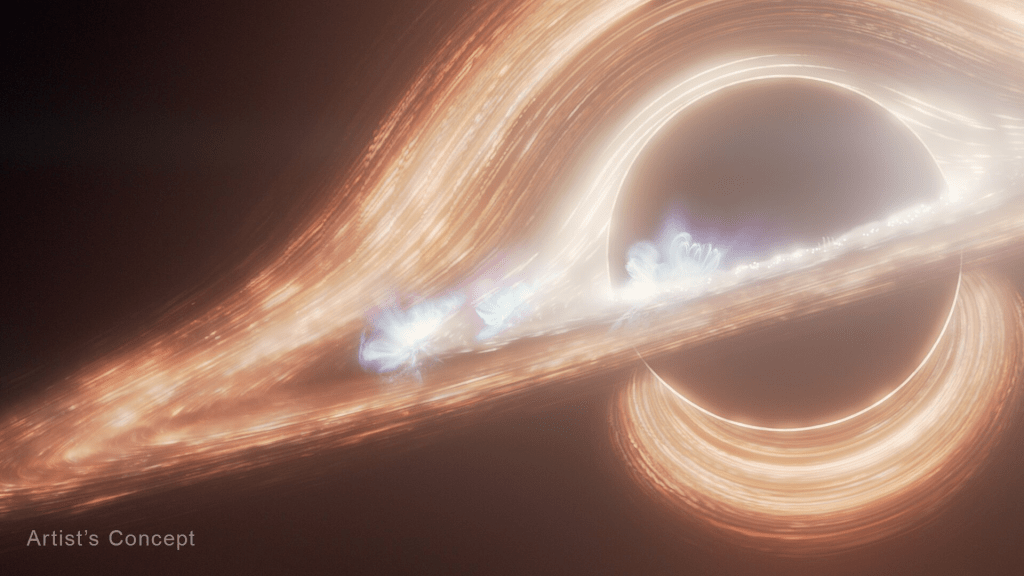
The death of a star and the birth of white dwarfs, neutron stars, and black holes
Most black holes are essentially a collapsed star, particularly ones that had very high mass during its lifetime. Stars generate energy through nuclear fusion, which is the combining of atoms into heavier atoms under extreme pressure. This process releases tremendous amounts of energy and pressure outwards, counteracting the core’s force of gravity pulling on the outer layers of the star. These two forces interact in a delicate balance, enabling the star to remain stable.
Stars undergo this process for millions or billions of years until they use up all available atoms they can utilize for fusion, breaking the balance between its core’s gravitational pull and the outward pressure generated from fusion. The outer layers of the star fails to withstand the gravitational pull of the core, collapsing into the core at a fraction of the speed of light. During this process, the fate of the star depends on its mass:
- If the star is less than 8 solar masses, it will become a white dwarf without a supernova explosion.
- If the star is between 8~20-30 solar masses, it will explode into a supernova, or the death of a star, and will shrink until its core is purely composed of neutrons. This is a neutron star.
But what would happen if the star is greater than 30 solar masses?
The star, its core now only made of neutrons, can no longer sustain the incredible mass of the star and collapses one last time. The core shrinks infinitely into a single point in space — a singularity. This is what we know as a black hole.
References
Kazmierczak, Jeanette, and Nasa Universe Web Team. “Stars – NASA Science.” NASA Science, 2 May 2025, science.nasa.gov/universe/stars.
Black Holes. http://www.esa.int/Science_Exploration/Space_Science/Black_holes.
 DarkLittleStar