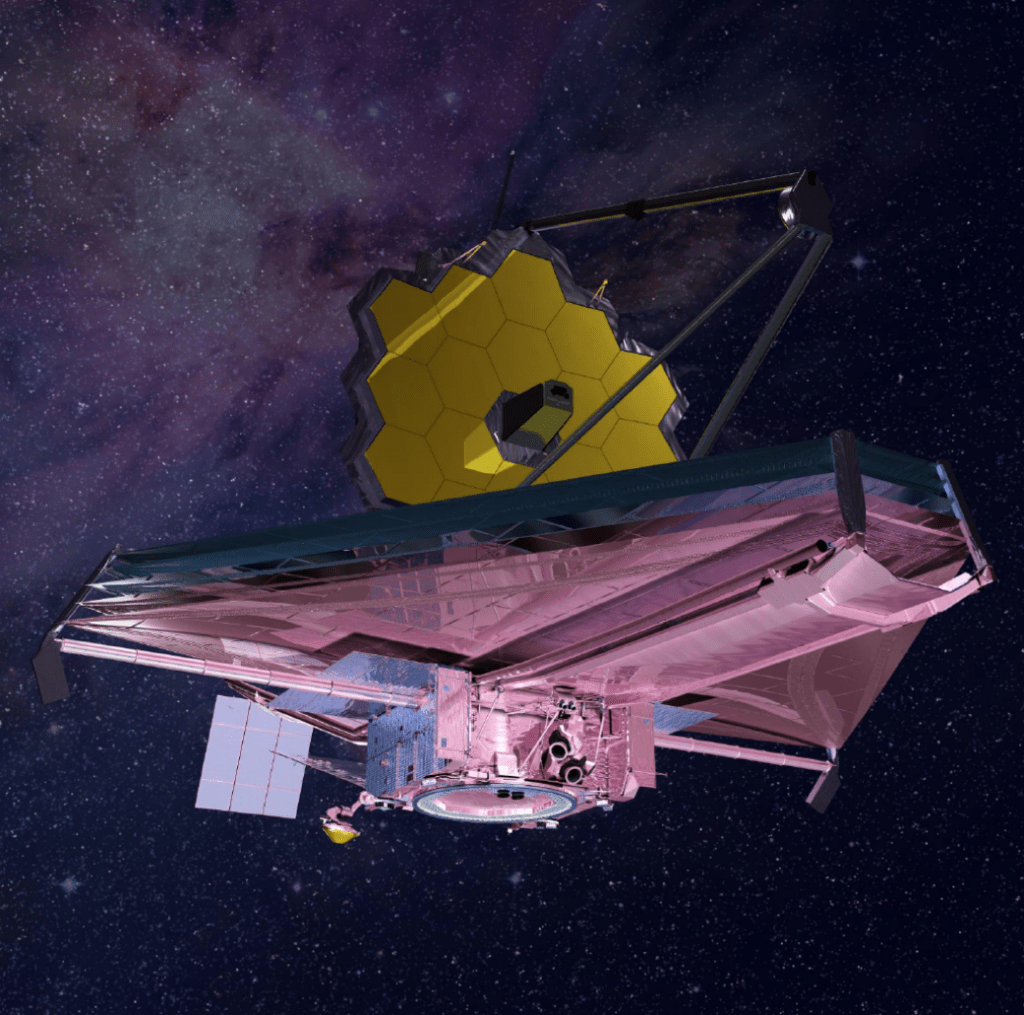
Introduction to NASA’s James Webb Space Telescope & how it observes our universe
The James Webb Space Telescope, known as the JWST, is a state-of-the-art telescope engineered by NASA. It has been successfully operating since its launch on December 25th, 20211.
The JWST is located about one million miles away from Earth at the second Sun-Earth Lagrange point (L2). A Lagrange point is where the gravitational force of two large orbiting objects create a region for a small object, such as a satellite or a telescope, to remain at a stable position relative to the two large bodies2.
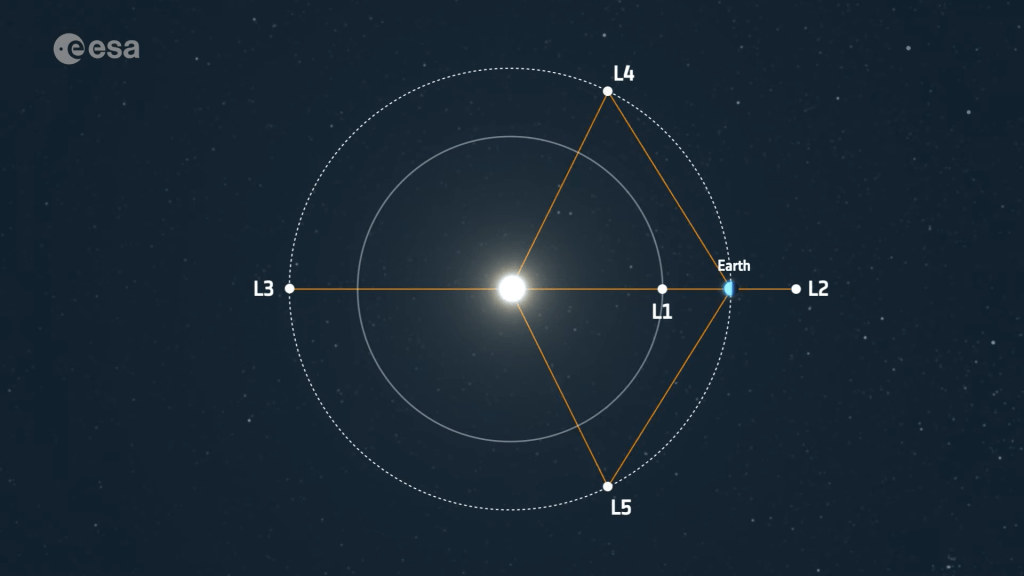
Credits: European Space Agency
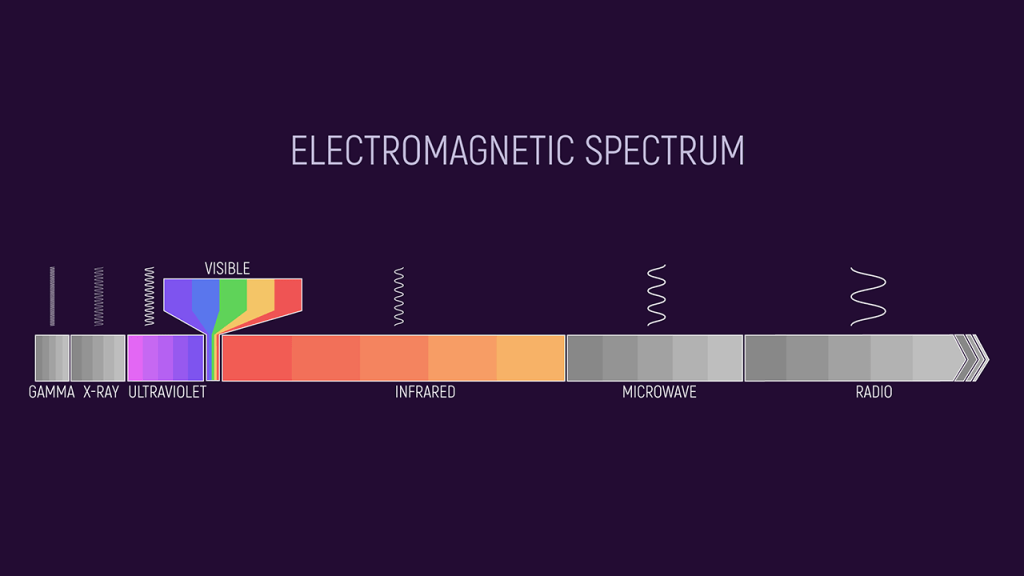
Unlike the Hubble Space Telescope, which collects light from the visible range of the electromagnetic spectrum, Webb observes the universe by collecting light from the infrared range3. Infrared lights have longer wavelengths that are unlikely to be blocked off by dense dust clouds and gases. Thus, there are higher chances for infrared light to reach Webb than visible light.
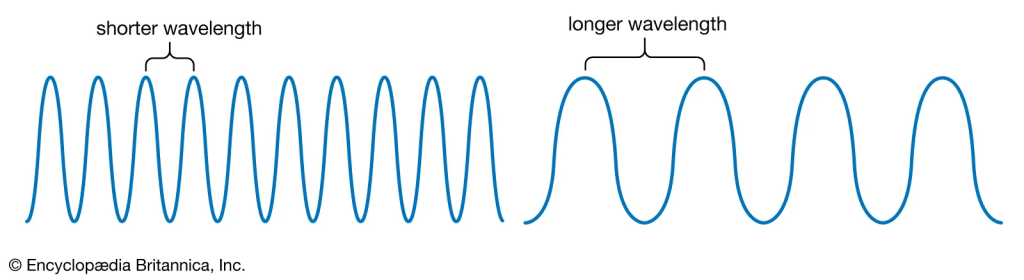
Credits: Britannica
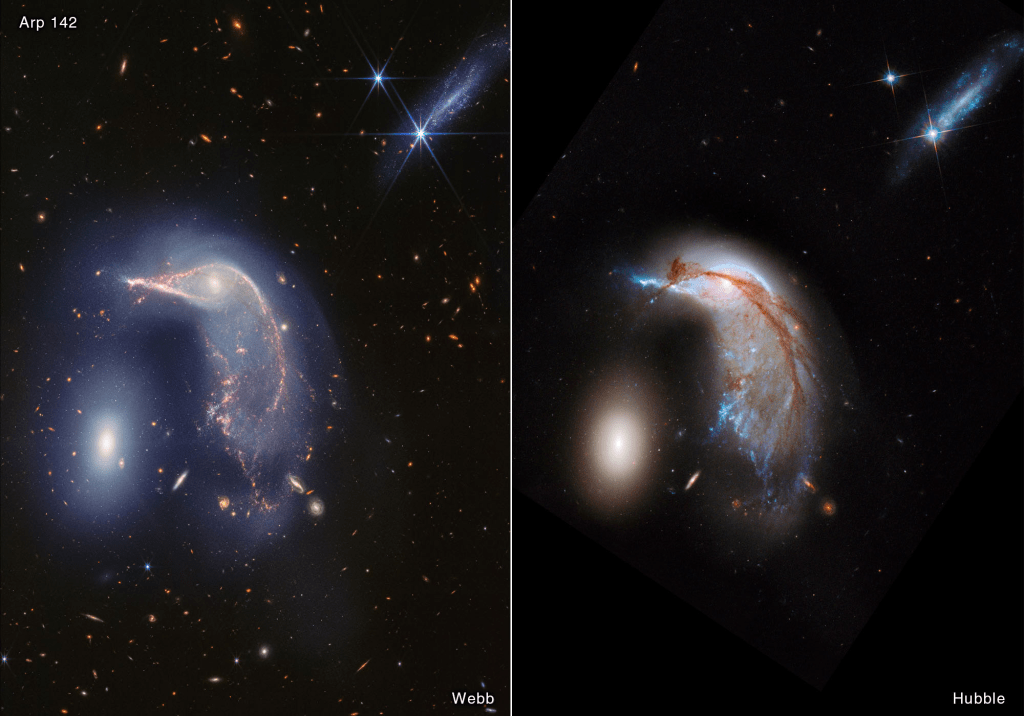
Credits: Webb Space Telescope
Cosmological Redshift
Not all stars or galaxies emit infrared light – some emit ultraviolet, visible, or even x-ray. However, Webb can still detect these galaxies or stars with a little help from our universe. A phenomenon called cosmological redshift causes light traveling through space to stretch along with the universe’s expansion.4 When the light stretches, its wavelengths become longer, shifting the light into a lower frequency. In other words, if a visible-light-emitting star is distant enough, its light will have stretched into infrared light by the time it reaches Webb. By gathering infrared light, Webb can observe the oldest, or farthest galaxies that formed shortly after the Big Bang.
Credits: Webb Space Telescope
A Time Machine
When we look at Webb’s images, we’re essentially looking into the past of our universe. Because light takes time to reach us, we see these galaxies as they were millions or billions of years ago.
For instance, the neighboring Andromeda Galaxy is about 2.5 million light years away. A light year is the distance light travels in a year, and it’s approximately 9.5 trillion kilometers. Andromeda is 2.5 million times that distance, which is an unimaginable journey. We receive Andromeda’s light 2.5 million years after it emitted it. So when we look up at it, we’re looking at it as it was 2.5 million years ago. If the Andromeda suddenly disappeared, we won’t know until 2.5 million years later when its last bit of light reaches us.
The James Webb Space Telescope lets us see the universe as it was billions of years ago. By capturing light that has traveled across space and time, it helps us learn about the first stars and galaxies. In this way, JWST acts like a time machine, showing us the early history of the cosmos and helping us understand where everything began.
References
- “Quick Facts.” Webb, webbtelescope.org/quick-facts. ↩︎
- Kaiser, Colleen, and Colleen Kaiser. “What Is a Lagrange Point? – NASA Science.” NASA Science, 2 Nov. 2024, science.nasa.gov/resource/what-is-a-lagrange-point/#:~:text=Of%20the%20five%20Lagrange%20points,large%20masses%20at%20their%20vertices. ↩︎
- “Infrared Astronomy.” Webb, webbtelescope.org/science/the-observatory/infrared-astronomy. ↩︎
- “Early Universe.” Webb, webbtelescope.org/science/early-universe. ↩︎
 DarkLittleStar