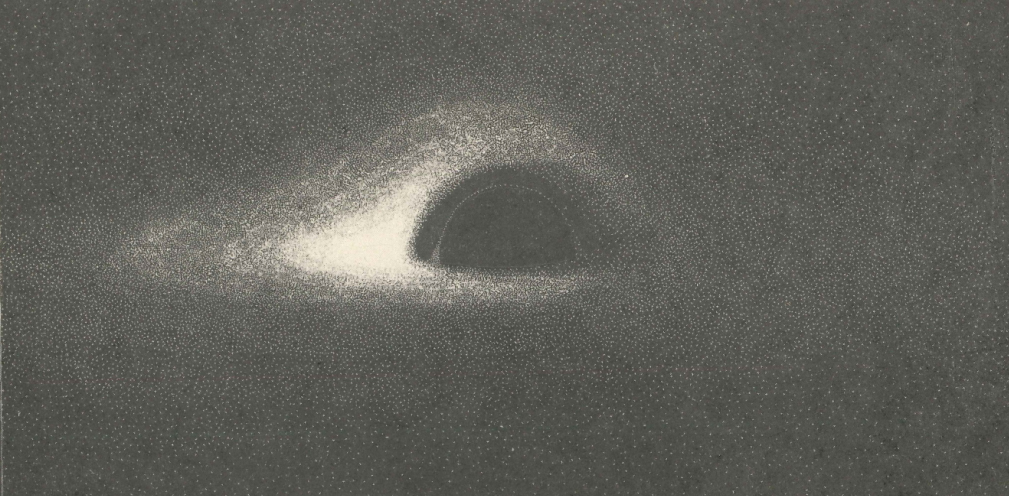
Einstein’s general relativity, Schwarzschild, and the LIGO
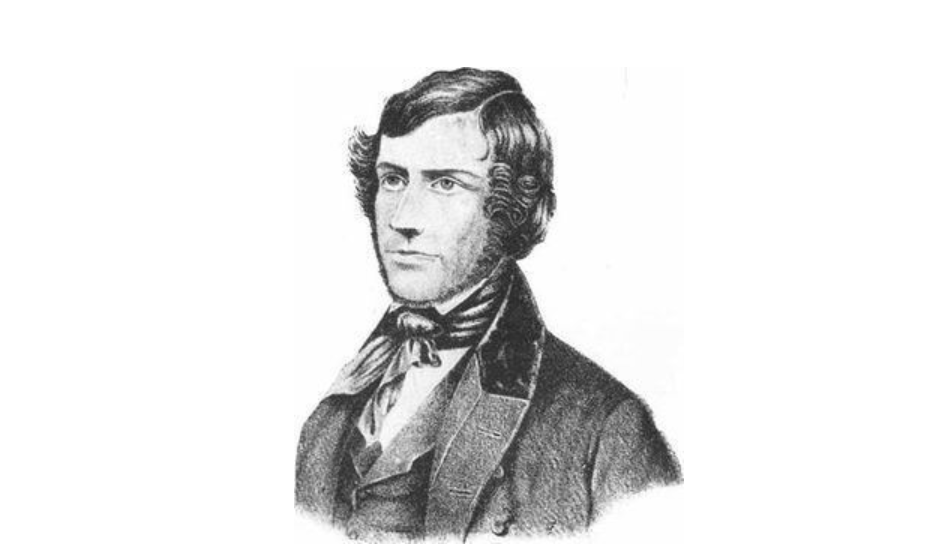
About 100 years after Newton published the Law of Universal Gravitation, philosopher John Michell introduced the first theoretical idea of a black hole.
The Dark Star
Michell thought deeply about gravity and its interaction between objects. He came to the conclusion that for an object to overcome Earth’s gravity, its kinetic energy, or its moving energy, must be greater than its gravitational potential energy (the gravity pulling the object downwards). This is the concept of escape velocity; the minimum velocity in which an object can overcome another object’s gravity and move away from it.
Credits: Boise State University
Derived from the concept of escape velocity, Michell thought of a fascinating alternative–he imagined gravity so intense that, for an object to escape its pull, its kinetic energy must be greater than the speed of light. In other words, no object would be able to escape it since nothing can exceed the speed of light. He called this object the “dark star”, opening up the possibility for a black hole for the first time. Famous French mathematician and physicist Pierre-Simon Laplace also supported Michell’s proposal.
However, his theory couldn’t be proven or observed in 1783 when the idea was proposed–the technology available at the time were far less developed then it is in the present, restraining any proofs or observations to be made about this theoretical dark star. Scientists in the 1700s, their knowledge based on Newtonian physics, also had a different understanding of gravity than humans do now. They criticized Michell’s theory, arguing that if light has no mass, it cannot be affected by gravity.
Einstein’s Breakthrough
The dark star theory remained in the dust until 1915 when physicist and mathematician Albert Einstein published his theory of general relativity. He thought of gravity in a different way incorporating his idea of spacetime, which considers time as a fourth dimension of the universe and therefore woven with the three dimensional space. According to Einstein, gravity is not a force, but rather a curvature in spacetime caused by mass, affecting both time and space. He described this phenomena in his Einstein Field Equation, overcoming the known concept of an absolute, unchanging space and time.
With the construction of his field equation, Einstein suggested that there would exist gravitational waves from massive objects that immensely bend spacetime. However, his field equation was so mathematically challenging that even Einstein himself could not solve it. It wasn’t until a few months later that German physicist Karl Schwarzschild provided the first sensical solution to the equation along with a valuable observation.
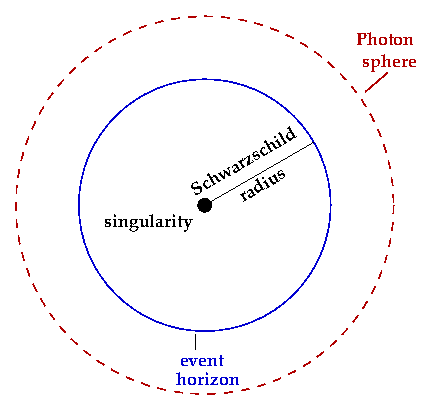
Schwarzschild noticed that there is a boundary in which if a star shrunk past it, the star would collapse into a single point under the pressure of its own gravity. This boundary is known as the Schwarzschild radius, with its is circumference being the event horizon. Nevertheless, scientists debated whether it would be physically possible for a star to shrink into such compact space and collapse–if the star was about the size of the Earth, it would have to shrink until the size of our thumb.
Credits: Galileo’s Pendulum
It wasn’t until 30 years later when scientists began to seriously consider the possibility of a black hole. After series of arguments and debates, they decided that detecting gravity waves as Einstein suggested would be the strongest evidence of a black hole. According to Einstein, objects that heavily bend spacetime cause “ripples”. These ripples would travel at the speed of light and emit in all directions from the source.
Scientists made great efforts to prove that gravity waves do actually exist. However, they were immensely hard to detect, mainly for three reasons.
Gravity waves have no medium in which they travel in. This made detecting it significantly difficult because it meant that they do not interact with matter for us to detect a change in. Scientists had to figure out a way to detect the tiniest amount of discontinuity in spacetime itself instead of in a measurable medium.
Gravity waves also do not have any “fields”. Electromagnetic waves likewise don’t have a medium, but we can detect them easily by their electric and magnetic fields. The waves of spacetime do not yield us an observable form of a field.
Gravity is also the weakest force in the universe and are often emitted from a source billions of light years away. Although they’re caused by catastrophic astronomical events, these waves are practically insignificant by the time it reaches Earth; they’re as small as a fraction of a proton. Detecting these unimaginably small distortions in spacetime pressured scientists to build one of the most precise instruments ever built.
The First Indirect Evidence
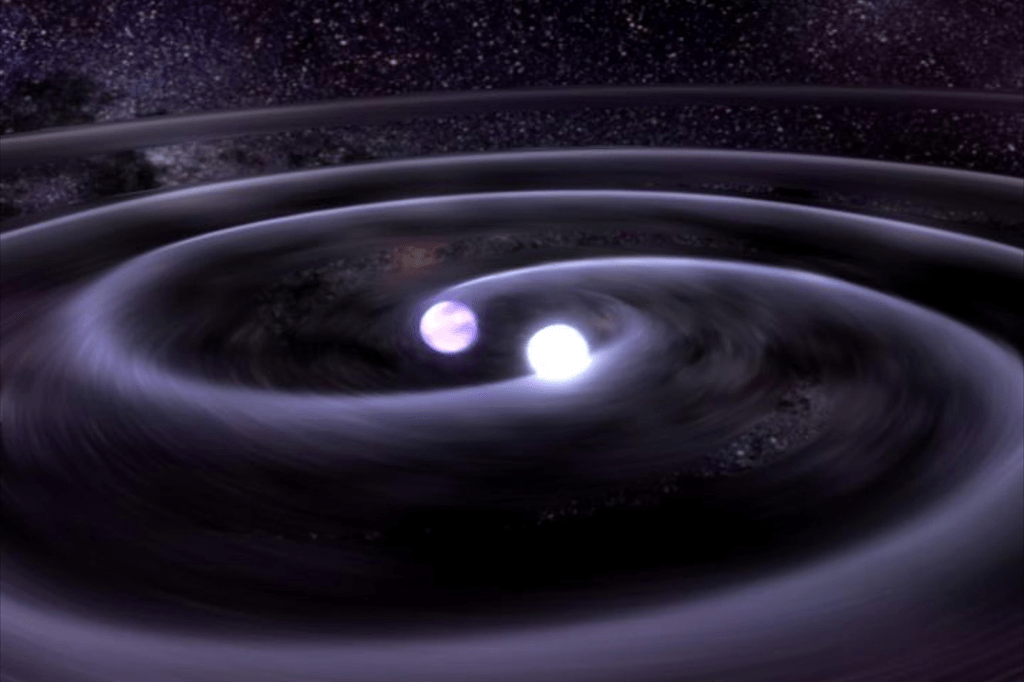
In 1974, physicists Joseph Taylor and Russell Hulse discovered a binary pulsar system, consisting of a pulsar orbiting a neutron star. They observed that the orbit period of these stars was decreasing over time, meaning that they were slowly approaching each other. Although the decline was microscopic, they strongly implied that these stars were emitting some kind of energy waves that made them lose their orbital energy and gradually get closer and closer towards each other.
In 1978, Taylor and Hulse finally concluded that the declining orbits of these binary neutrons stars are caused by their emission of gravitational waves. Their discovery was mathematically identical to Einstein’s Field Equation and therefore produced an indirect proof of the reality of gravitational waves.
Credits: National Geographic
Taylor and Hulse were awarded the Nobel Prize in Physics in 1993 for their contributions to a new possibility for the study of gravitation and the discovery of a new type of pulsar.
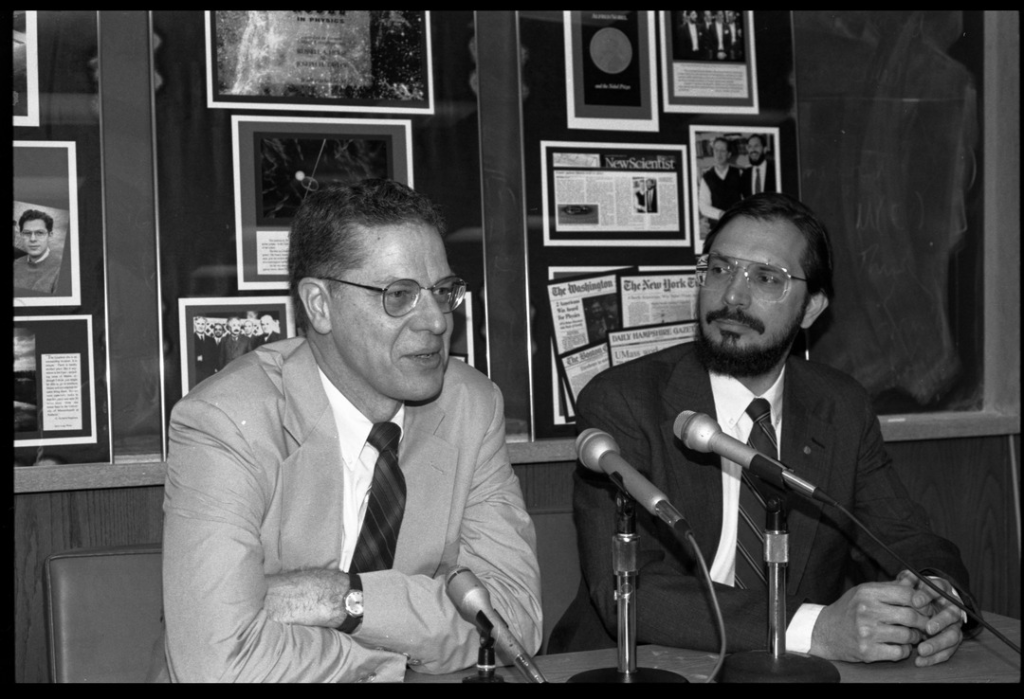
Credits: UMass Amherst
The First Direct Evidence
The Laser Interferometer Gravitational-Wave Observatory (LIGO) was uniquely designed for the study of gravitational-wave astrophysics, with one site located in Hanford, Washington and the other in Livingston, Louisiana. Engineered by hundreds of scientists, engineers, and staff from Caltech and MIT, the LIGO’s massive 4-kilometer long detectors were built to measure out the tiny ripples in spacetime using laser interferometry.
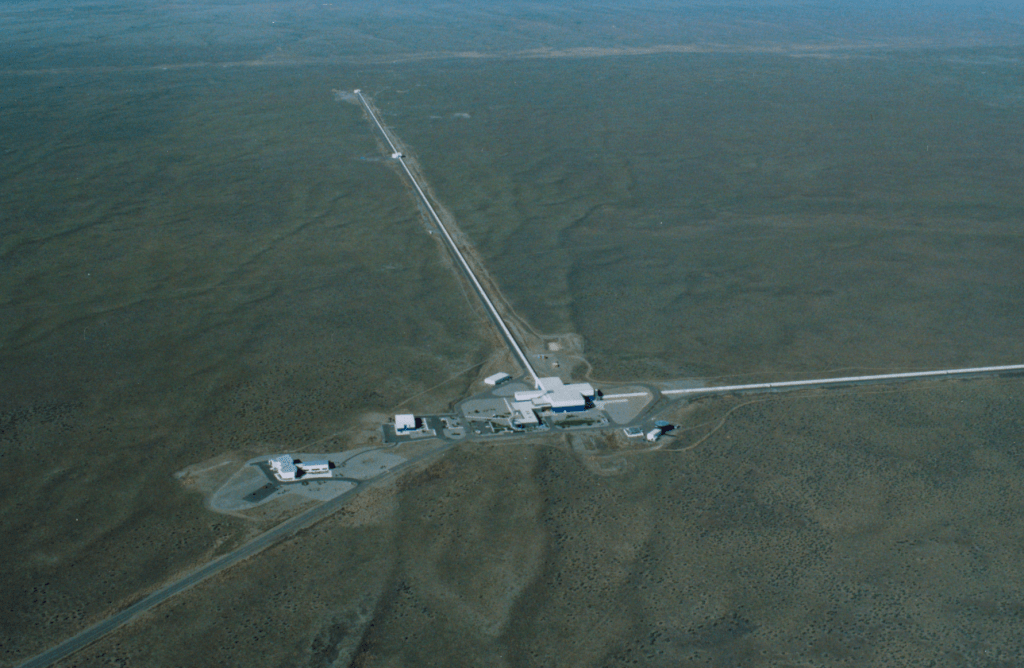
Credits: LIGO Caltech
During the first five years of its operation, the LIGO remained quiet–no detections of gravitational waves. LIGO was significantly refined and upgraded and was put back into work In collaboration with institutions all around the world.
In February 2016, the National Science Foundation announced that the LIGO had successfully detected gravitational waves for the first time in human history. The waves were emitted from a pair of colliding black holes 1.3 billion light years away from Earth.
.
.
.
.
Author’s Insight
It’s hard to describe what I felt when researching how black holes were imagined, and then discovered. I think I was first inspired by all the effort, creativity, and curiosity these scientists all had. It was like magic seeing the theoretical part of the imagination, like Mitchell’s Dark Star, getting worked out to be proven true by empirical evidence, like the LIGO. It resonated with me that the endless universe we live in really just follows the rules humans can define. Hence, I’m beyond thrilled to see what the next milestone is in our journey through the cosmos.
References
What are Gravitational Waves? (n.d.). LIGO Lab | Caltech. https://www.ligo.caltech.edu/page/what-are-gw
리뷰엉이: Owl’s Review. (2022, January 26). 무려 100년 전에 블랙홀의 존재를 예측한 천재 과학자 아인슈타인 [Video]. YouTube. https://www.youtube.com/watch?v=ADLqaoP16HU
리뷰엉이: Owl’s Review. (2022b, January 29). 100년 전 아인슈타인이 또 한 번 옳았다! 중력파로 블랙홀의 충돌을 관측해낸 LIGO [Video]. YouTube. https://www.youtube.com/watch?v=2DMOlt8s7Tg
Nobel Prize in Physics 1993. (n.d.). NobelPrize.org. https://www.nobelprize.org/prizes/physics/1993/press-release/
About. (n.d.). LIGO Lab | Caltech. https://www.ligo.caltech.edu/page/about
 DarkLittleStar
Leave a comment