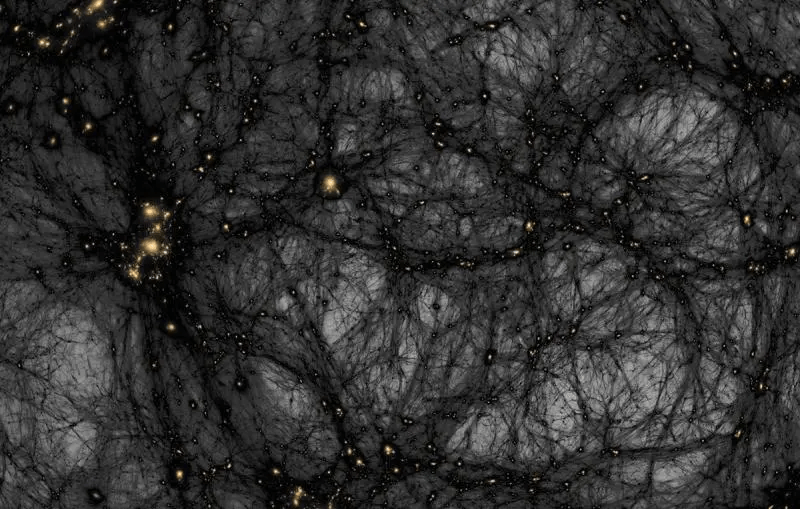
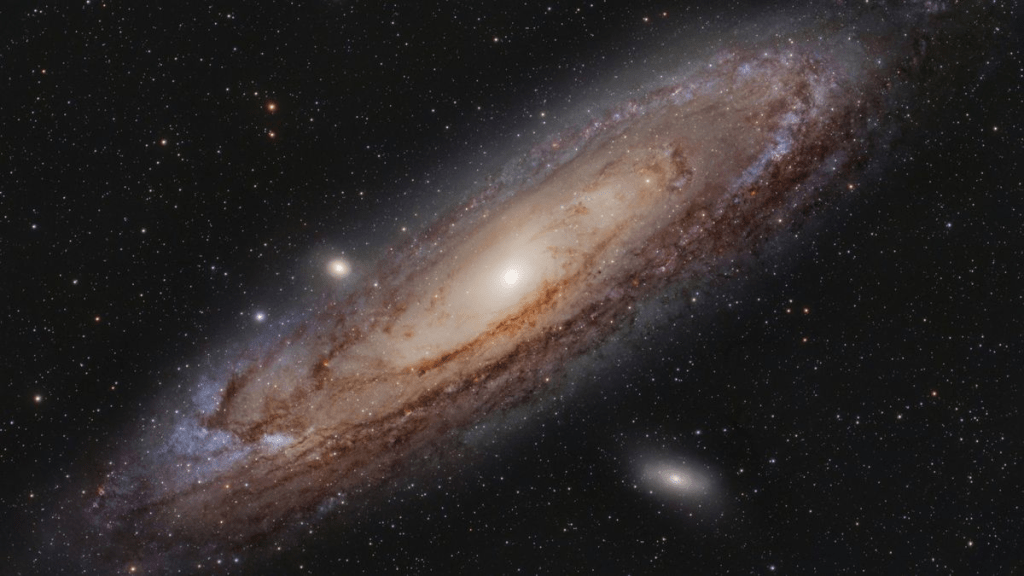
Galaxies are among the most beautiful objects in the universe. Containing millions or billions of stars just like our Sun, they spiral around space in many different structures. Some galaxies are dwarf galaxies containing only a few million stars. Most are unimaginably big, spanning hundreds of thousands of light-years across. Scientists have wondered how these giant clusters of matter keep their disk-like, spiral shape over time. Based on countless observations, astronomers were led to a surprising conclusion: a counterpart of visible matter, known as dark matter.
At first glance, it might seem obvious that the gravity from stars themselves is enough to keep a galaxy together. However, when astronomers measured how fast stars move within galaxies, they found that stars near the outer edge of the spiral travel much faster than expected. According to the laws of gravity, galaxies do not contain enough visible matter to keep these stars in orbit. The outer regions of galaxies should be slowly drifting apart into space. Yet galaxies remain stable for billions of years.
Common Misconceptions About What Holds Galaxies Together
It is widely known that there are supermassive black holes at the center of large galaxies, and that their gravitational influence is the reason why galaxies stay as a whole. However, while it’s true that their intense gravity dominate the central area of the galaxy, their gravity does not reach stars further away towards the outskirts of the disk.
People also sometimes imagine galaxies rotating like solid objects, where outer parts move slower than inner parts. In reality, the rotational speed of stars near the galaxy’s center and towards the edge of the disk are nearly constant. It’s unusual to have stars at such different distances from the center moving at nearly the same speed, because according to visible matter alone, the outer stars should orbit much more slowly. This unexpected behavior is one of the main pieces of evidence for the existence of dark matter, which provides extra gravitational pull throughout the galaxy.
What Is Dark Matter?
To be honest, we don’t really know. Scientists have not yet figured out the exact constituents of dark matter. All we know is that they’re invisible matter that exerts gravitational forces in the same way that visible matter do. They contribute to the rotational speed of outer stars in galaxies by adding extra mass to the galaxy that increases the gravitational pull on stars far from the center. Without this additional unseen mass, the outer stars would orbit much more slowly than we actually observe.
This invisible matter, though still a mystery, is essential for keeping galaxies intact. Without it, the beautiful spiral structures we see would not last billions of years. Studying dark matter helps astronomers understand the hidden forces shaping our universe.
 DarkStar
Leave a comment